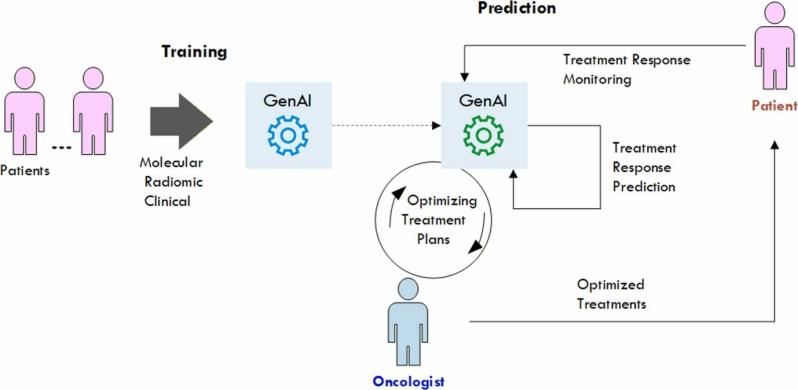
Adaptive therapy has emerged as a promising strategy to delay or overcome therapeutic resistance in cancer. However, its clinical success depends on effective treatment response monitoring and prediction. In this new Perspective, Youcef Derbal proposes a novel framework that integrates mathematical modeling, control theory, and generative artificial intelligence (GenAI) to bootstrap the development and clinical deployment of treatment response prediction models in metastatic prostate cancer (mPC).
The article explores the theoretical feasibility of this framework using a selective state-space Mamba model trained on virtual patients synthesized from a mathematical model of mPC treated with triplet therapy. The model achieved a prediction mean squared error of 3.43120×10⁻³, supporting the potential of GenAI as a catalyst for real-time treatment response prediction and adaptive therapy.
The Clinical Challenge
Cancer treatment can be framed as a problem of controlling time-varying nonlinear dynamical systems. Unlike engineered systems, cancer presents unique challenges:
Mathematical and GenAI models are driven by biological insights and empirical data, not first principles.
Therapeutic options are limited, with narrow effective dose ranges and toxicity concerns.
Combination therapies target multiple dimensions of cancer but increase toxicity.
Longitudinal monitoring of biomarkers remains difficult due to lack of standardization, cost, and sensitivity/specificity issues.
In mPC, prostate-specific antigen (PSA) is the primary biomarker, but other markers such as lactate dehydrogenase (LDH), alkaline phosphatase (ALP), circulating tumor cells (CTCs), and chromogranin A (CgA) are also used. The challenge is to predict treatment response from these longitudinal measurements and adapt therapy accordingly.
A GenAI-Supported Framework
The proposed framework recasts cancer therapy as a nonlinear control problem and uses GenAI to learn the unknown mapping between treatment inputs and biomarker outputs. Key elements include:
Control-theoretic framing: Cancer treatment is modeled as controlling the trajectory of tumor clonal frequencies under therapy.
Selective state-space model: A Mamba model is used for sequence-to-sequence prediction of treatment response.
Virtual patient generation: A mathematical model of mPC under triplet therapy (abiraterone, relugolix, and docetaxel) generates synthetic training data.
Multi-biomarker prediction: The model predicts PSA, testosterone, LDH, ALP, CTC, and CgA trajectories.
The model was configured with a model dimension of 32, state dimension of 16, convolution width of 4, and expansion factor of 2. It was trained on data from 500 virtual patients, with an 80% training and 20% validation split.
Key Findings
The selective state-space Mamba model demonstrated strong predictive performance across six biomarkers.
The global mean squared error (MSE) was 3.43120×10⁻³ across 100 synthetic patients.
Training took less than one hour on a single NVIDIA H100 GPU with 10 GB of memory.
The results support the theoretical feasibility of using selective state-space models for treatment response prediction.
The author emphasizes that these findings are based on synthetic data and should not be directly generalized to real-world clinical settings.
Clinical and Research Implications
The proposed framework may support clinical decision-making in two ways:
“What-if” treatment scenario simulations: Oncologists can input proposed treatment schedules and forecast expected biomarker responses to optimize therapy plans.
Closed-loop adaptive therapy: Predictive models can be embedded within adaptive treatment systems, where forecasts serve as feedback to dynamically adjust therapy.
For researchers, the article provides a concrete "how-to" process for integrating mechanistic mathematical models with data-driven GenAI. It also highlights the importance of fine-tuning on real-world data, validating with independent cohorts, and explicitly considering the tumor microenvironment, treatment toxicity, and disease severity.
Challenges and Future Directions
The author candidly identifies several barriers to clinical adoption:
Data challenges: sparse, irregular, and confounded real-world clinical data.
Model limitations: need for multimodal data such as circulating tumor DNA to link latent states to clonal frequencies.
Ethical and safety issues: hallucination, transparency, interpretability, uncertainty quantification, and accountability.
Regulatory and workflow integration: need for standardized metrics, dedicated trial infrastructures, and streamlined regulatory pathways.
Human-in-the-loop protocols: ensuring decision authority remains with oncologists.
Bioethical frameworks: guiding responsible AI use in clinical settings.
Conclusion
This Perspective offers a timely and rigorous exploration of how GenAI can be integrated with mathematical modeling and control theory to advance adaptive cancer therapy. While the study demonstrates theoretical feasibility using synthetic data, translating this potential into clinical impact will require real-world data fine-tuning, independent validation, safety evaluation, and robust ethical and regulatory frameworks.
Full article available on ScienceDirect:
https://www.sciencedirect.com/science/article/pii/S2950261626000476?via%3Dihub
Contact Information for Intelligent Oncology:
LinkedIn: @IntelligentOncology
X: @IntelligentOnco
Facebook: @intelligentoncology
Email Address: editorialoffice@intelligent-oncology.net
Official Website: https://www.sciencedirect.com/journal/intelligent-oncology
Submission Link: https://www2.cloud.editorialmanager.com/intonc/default2.aspx