Neural stem cells are being explored as carriers of anticancer payloads for malignant brain tumors. But a key question remains: which features of these therapeutic cells could help sustain tumor suppression, rather than produce only a temporary response? Computational modeling offers a way to explore this question before moving to experimental testing.
A new study, "AI-assisted nonlinear dynamical modeling of neural stem cell-mediated brain tumor suppression," by Val Hyginus Udoka Eze and colleagues, published in Intelligent Oncology, combines an interpretable mathematical model with AI-assisted parameter exploration to investigate tumor–neural stem cell interactions and prioritize hypotheses for future experiments.
Highlights:
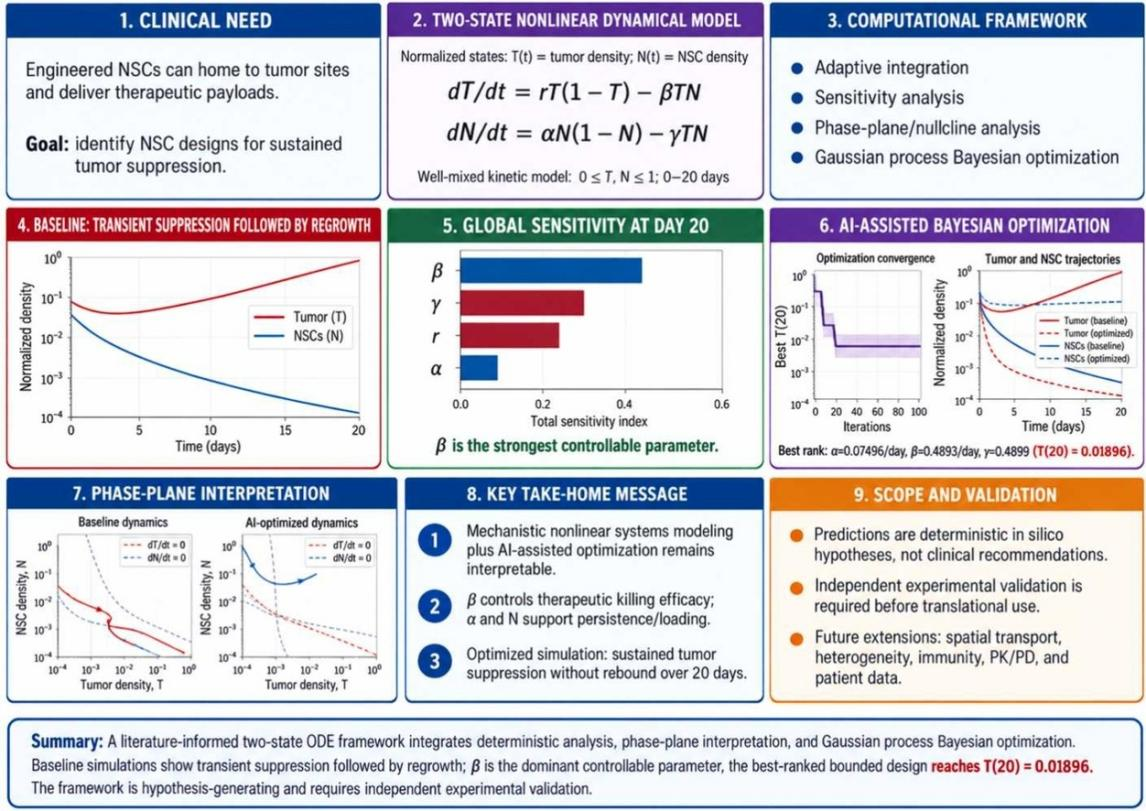
Mechanisms made interpretable: A two-state nonlinear model tracks tumor and neural stem cell populations, linking tumor growth, cell persistence, tumor-cell killing, and tumor-induced loss of therapeutic cells.
Identifying what matters most: Local and global sensitivity analyses identify the neural stem cell-mediated tumor-killing coefficient as the dominant controllable parameter within the investigated ranges.
AI-guided parameter exploration: Gaussian process–based Bayesian optimization searches combinations of neural stem cell persistence, killing potency, and initial cell density using 30 model evaluations.
Contrasting simulated outcomes: Baseline simulations show temporary suppression followed by tumor regrowth, while the optimized configuration maintains suppression over the 20-day simulation period within the specified search bounds.
A roadmap for validation: The simplified, well-mixed model supports hypothesis generation. Spatial migration, immune interactions, and experimental validation remain essential directions for future work.
A key takeaway: within this model, enhancing tumor-killing potency emerges as a stronger priority than simply increasing neural stem cell persistence. Combining mechanistic modeling with Bayesian optimization can help rank candidate conditions for experimental testing.
Full article available on ScienceDirect:
https://www.sciencedirect.com/science/article/pii/S295026162600049X
Contact Information for Intelligent Oncology:
LinkedIn: @IntelligentOncology
Bulesky: @Intelligent Oncology
X: @IntelligentOnco
Facebook: @intelligentoncology
Email Address: editorialoffice@intelligent-oncology.net
Official Website: https://www.sciencedirect.com/journal/intelligent-oncology
Submission Link: https://www2.cloud.editorialmanager.com/intonc/default2.aspx