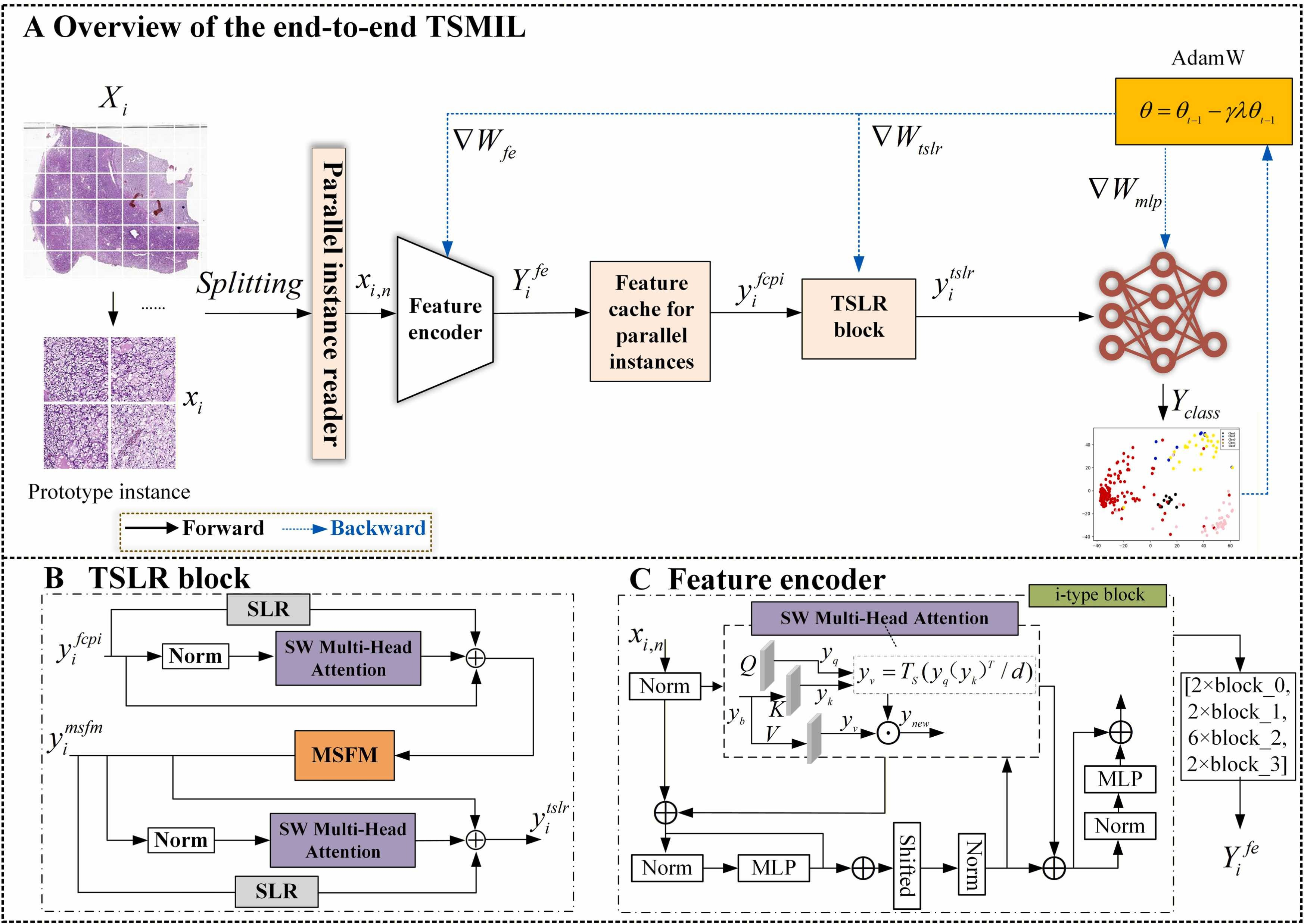
Renal cell carcinoma accounts for nearly 90 % of kidney cancers, and accurate histopathological subtyping is crucial for diagnosis, prognosis, and treatment. However, the gigapixel size of WSIs and the lack of pixel‑wise annotations make traditional deep‑learning approaches challenging. Most existing multiple instance learning methods treat tissue patches independently, losing global contextual dependencies and struggling with class imbalance or indistinct tumour boundaries.
A research team from Chongqing University, Peking University School and Hospital of Stomatology & NHC Key Laboratory of Digital Stomatology, and The Hong Kong Polytechnic University has developed TSMIL-a Transformer‑based structured low‑rank multiple instance learning network. Published in Intelligent Oncology.
TSMIL overcomes these limitations through three key innovations:
Multilayer spatial feature module(MSFM)
Transformer-based structured low-rank (TSLR) block
End-to-end Transformer with linear complexity
Results on RCC datasets:
Mean accuracy: 92.98% (AUC 0.9818)
Outperforms 11 state-of-the-art methods, including TransMIL and DGRMIL
Handles rare subtypes (e.g., chromophobe RCC with only 13 cases) where others scored zero
Strong generalization: 96.05% on TCGA-RCC external cohort
Statistically significant gains (P≤ 0.05) in five-fold cross-validation.
Interpretability and clinical relevance:
Beyond quantitative metrics, TSMIL provides meaningful visual explanations. Attention heatmaps and feature-space visualisations (PCA, t-SNE) show that TSMIL produces well-separated clusters for each RCC subtype and highlights tumour regions that closely match pathologist annotations. The model effectively suppresses common artefacts (hemorrhage, necrosis, surgical ink) that trigger false positives in other methods, and its spatial continuity maps the entire tumour parenchyma instead of scattered patches.
Full article available on ScienceDirect:
https://doi.org/10.1016/j.intonc.2026.100057
Contact Information for Intelligent Oncology:
LinkedIn: @IntelligentOncology
X: @IntelligentOnco
Facebook: @intelligentoncology
Email Address: editorialoffice@intelligent-oncology.net
Official Website: https://www.sciencedirect.com/journal/intelligent-oncology
Submission Link: https://www2.cloud.editorialmanager.com/intonc/default2.aspx