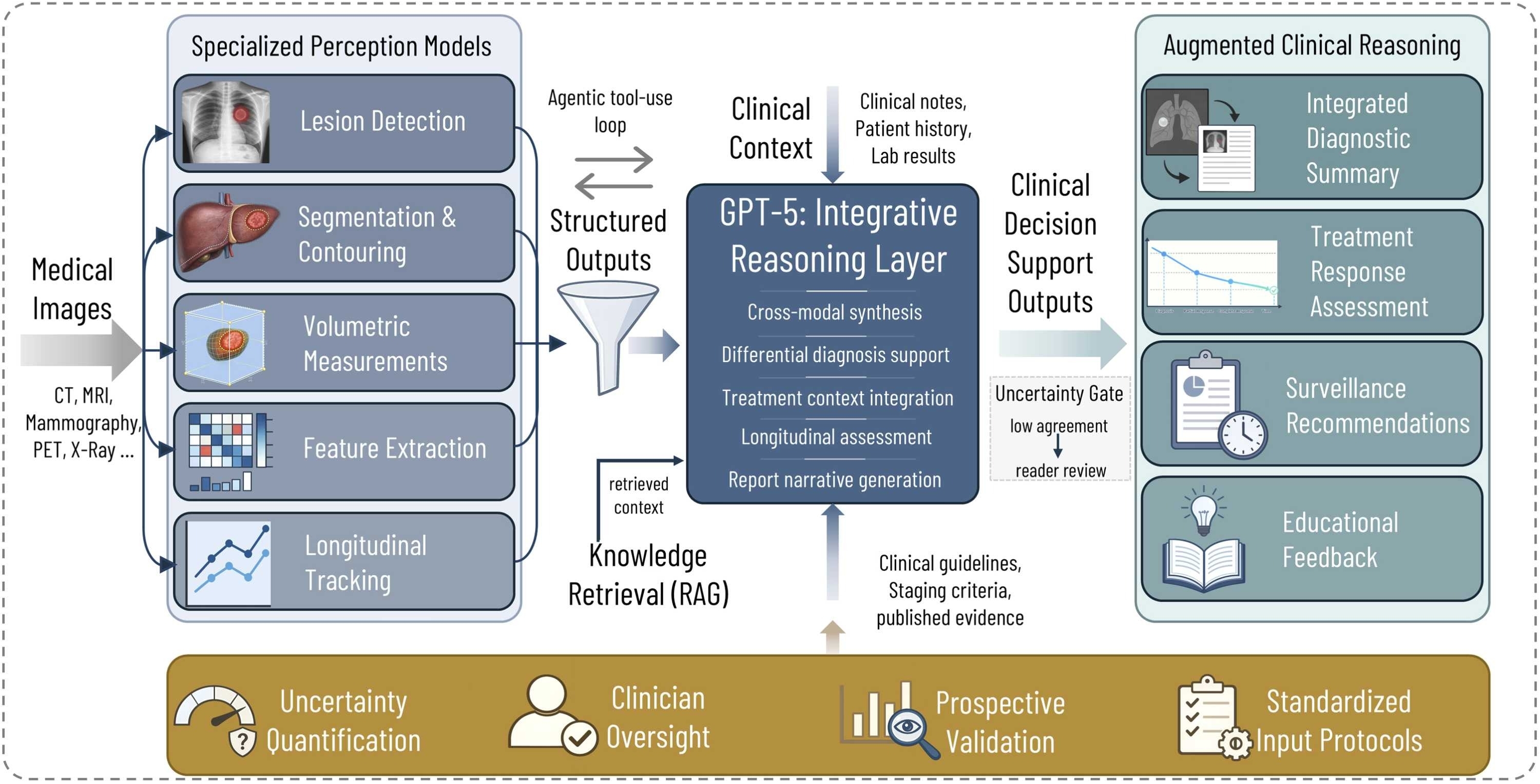
Medical imaging demands more than strong reasoning: subtle visual patterns, precise measurements, and changes across successive scans can all shape clinical decisions. As multimodal AI advances, a key question is how general-purpose models can work with specialized imaging tools to support oncology care.
A commentary, "GPT-5 in medical imaging: Early evidence and the case for hybrid oncology workflows," by Nalan Karunanayake of Memorial Sloan Kettering Cancer Center, published in Intelligent Oncology (Volume 2, Issue 4), examines seven early evaluations of GPT-5 and proposes a hybrid approach to oncology imaging.
Highlights:
Stronger reasoning in structured tasks: GPT-5 improves over GPT-4o on several reasoning-intensive and examination-style benchmarks, but these gains do not consistently translate into applied clinical scenarios.
A persistent perception gap: Fine-grained image interpretation remains challenging. Early mammography and brain tumor MRI evaluations highlight limitations in visual discrimination and spatial understanding.
A proposed division of labor: Specialized tools perform detection, segmentation, and quantitative measurement, while GPT-5 integrates their structured outputs with clinical context to support reasoning.
Oncology applications to investigate: Response assessment, surveillance, and treatment sequencing offer potential settings for this approach, where imaging findings must be interpreted alongside prior examinations and other patient information.
Validation and oversight are essential: Confident errors, prompt sensitivity, and three-dimensional reasoning constraints remain concerns. Prospective evaluation, uncertainty signaling, and clinician review are central to the proposed workflow.
A key takeaway: the commentary positions GPT-5 as an integrative reasoning layer that augments expert readers. By making detection, measurement, and subsequent reasoning separately reviewable, a hybrid workflow could help teams trace errors and assess reliability. Its clinical value still requires prospective validation.
Looking ahead: From GPT-5 to GPT-6, the next chapter in medical imaging is worth watching. A priority for future research is to determine whether newer models can improve multimodal integration and longitudinal reasoning within clinically supervised workflows. Each generation will need task-specific testing to establish whether benchmark progress translates into reliable clinical benefit.
Full article available on ScienceDirect:
https://www.sciencedirect.com/science/article/pii/S2950261626000506
Contact Information for Intelligent Oncology:
LinkedIn: @IntelligentOncology
Bluesky: @Intelligent Oncology
X: @IntelligentOnco
Facebook: @intelligentoncology
Email Address: editorialoffice@intelligent-oncology.net
Official Website: https://www.sciencedirect.com/journal/intelligent-oncology
Submission Link: https://www2.cloud.editorialmanager.com/intonc/default2.aspx