Routine pathology slides reveal how a tumor looks—but could they also offer clues to its chromosomal instability (CIN) ? CIN is relevant to breast cancer prognosis and treatment stratification, yet laboratory-based assessment can be time-consuming and costly. Predicting CIN from H&E-stained WSIs requires AI models to connect local cellular patterns with the surrounding tissue architecture.
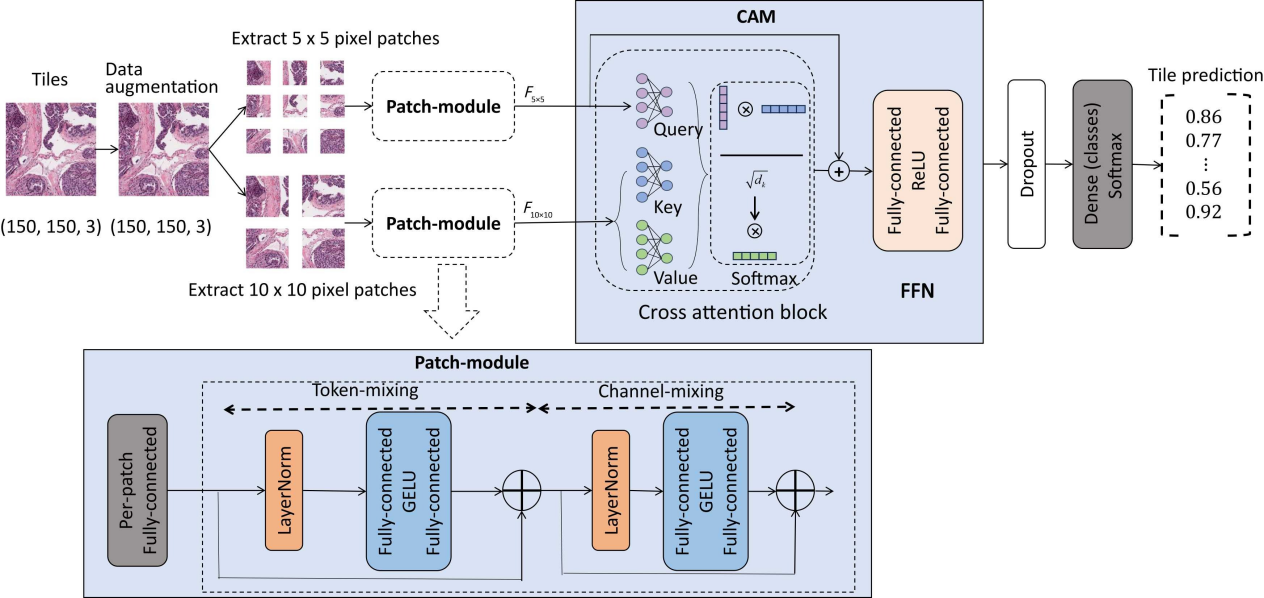
A study published in Intelligent Oncology (Volume 2, Issue 4) introduces MSCAnet, a multi-scale cross-attention network designed to predict CIN status from routine breast cancer histology.
The primary contributions of this paper are as follows:
1.This study proposes MSCAnet, a task-adaptive neural network tailored for CIN prediction that addresses the inherent challenge of balancing local nuclear details with global tissue context in gigapixel WSIs, thereby overcoming the limitations of generic multi-scale and single-branch models.
2.A dedicated cross-attention module is designed to calibrate feature fusion using expert-annotated CIN prototypes, ensuring the model prioritizes biologically relevant features and bidirectionally refines features between branches.
3.MSCAnet achieves the highest numerical performance under the evaluated fixed partition on the TCGA-BRCA dataset and provides interpretable visualizations of 4.CIN-related morphological heterogeneity across WSI regions, with qualitative correspondence to pathologist annotations.
5.The framework was preliminarily evaluated for HER2 status prediction, achieving an accuracy of 82.72%, which provides preliminary evidence of task transferability to another molecular status prediction task.
A key takeaway
The study highlights the potential of combining cellular and tissue-scale information to extract molecularly relevant signals from routine histology. CIN scores and spatial prediction maps could eventually provide supplementary information for pathologists reviewing heterogeneous tumors. The present evidence comes from a retrospective study using a fixed patient-level data split, with intermediate CIN cases excluded from the main analysis. The findings therefore support further investigation of MSCAnet as a decision-support approach; they do not establish readiness for routine clinical use.
Looking ahead
The next steps are to test MSCAnet in independent, multicenter cohorts and prospective workflows, and to extend prediction across the full CIN spectrum. Higher-resolution inputs and integration with molecular and clinical data may help address the limits of morphology alone. Future studies will need to establish whether these advances improve robustness across institutions and provide reliable, useful information for clinical decision-making.
Full article available on ScienceDirect:
https://doi.org/10.1016/j.intonc.2026.100091
Contact Information for Intelligent Oncology:
LinkedIn: @IntelligentOncology
Bluesky: @Intelligent Oncology
X: @IntelligentOnco
Facebook: @intelligentoncology
Email Address: editorialoffice@intelligent-oncology.net
Official Website: https://www.sciencedirect.com/journal/intelligent-oncology
Submission Link: https://www2.cloud.editorialmanager.com/intonc/default2.aspx