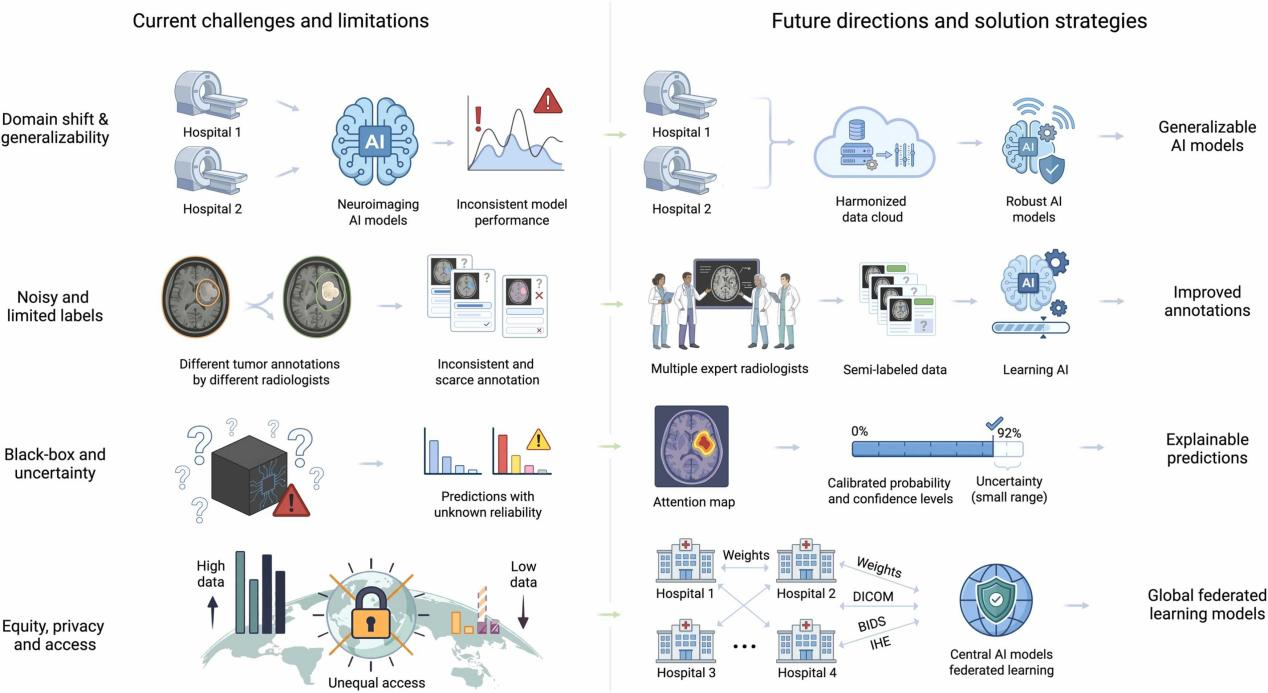
A comprehensive review published in Intelligent Oncology (Volume 2, Issue 3) examines how AI is reshaping neuro-oncology imaging—moving the field from subjective, reader-dependent interpretation toward quantitative, reproducible decision support. Authors from Chulalongkorn University, the London School of Hygiene and Tropical Medicine, and other institutions worldwide synthesized evidence across automated detection, segmentation, grading, and longitudinal monitoring of brain tumors using multiparametric MRI and hybrid PET/MRI.
Key Advances
The review highlights several transformative capabilities of AI in brain tumor imaging:
Automated segmentation and volumetry — Deep learning pipelines (e.g., nnU-Net, Swin UNETR) now delineate enhancing tumors, non-enhancing tumors, edema, and postoperative cavities with Dice scores exceeding 0.90 on benchmark datasets, achieving results up to 20× faster than manual contouring with intraclass correlation coefficients of approximately 0.96, matching experienced radiologists.
Radiogenomic characterization — AI models link imaging phenotypes to WHO CNS5 molecular markers, including IDH mutation, 1p/19q codeletion, and MGMT promoter methylation, enabling non-invasive molecular profiling that complements tissue-based testing.
Multimodal response assessment — Integration of MRI radiomics, perfusion imaging, MR spectroscopy, and amino-acid PET (FET, FDOPA) enhances differentiation of true progression from pseudoprogression—one of the most persistent clinical challenges in post-treatment neuro-oncology.
Implementation Challenges
Despite promising performance, the review identifies critical barriers to clinical adoption:
Domain shift and data heterogeneity — Model performance drops of 0.04–0.17 in Dice scores are commonly reported when transferring between scanners, protocols, and institutions, underscoring the need for harmonization and domain adaptation strategies.
Workflow integration — AI tools must seamlessly integrate with PACS, RIS, and EHR systems via standards such as DICOM Structured Reporting, BIDS, and IHE AI Results profiles to minimize radiologist friction and cognitive load.
Regulatory readiness — Compliance with FDA Software as a Medical Device (SaMD) guidance and the evolving EU Medical Device Regulation and AI Act is essential, alongside transparent reporting using TRIPOD+AI and PROBAST+AI frameworks.
Probability calibration and clinical utility — The authors emphasize that reporting should extend beyond discrimination metrics (AUC) to include calibration plots, Brier scores, and decision curve analysis—ensuring that predicted probabilities faithfully map to real-world event rates and demonstrate net clinical benefit.
Future Directions
The review outlines five actionable priorities for translating AI into routine neuro-oncology practice:
Prospective, multi-reader multi-case validation in real-world workflows
Routine reporting of probability calibration and decision curve analysis alongside discrimination metrics
Explicit uncertainty quantification and drift monitoring post-deployment
Adherence to AI-specific reporting and risk-of-bias standards (TRIPOD+AI, PROBAST+AI) with standards-first interoperability
Evaluation against clinically meaningful endpoints—time to report, change in management, and patient outcomes—rather than retrospective accuracy alone
The promise of intelligent oncology lies not only in faster, more accurate diagnosis, but in delivering reproducible, quantitative decision support that empowers clinicians to make more confident treatment decisions—particularly in complex post-treatment settings where pseudoprogression, radiation effects, and true recurrence overlap.
Full article available on ScienceDirect:
https://doi.org/10.1016/j.intonc.2026.100071
Contact Information for Intelligent Oncology:
LinkedIn: @IntelligentOncology
X: @IntelligentOnco
Facebook: @intelligentoncology
Email Address: editorialoffice@intelligent-oncology.net
Official Website: https://www.sciencedirect.com/journal/intelligent-oncology
Submission Link: https://www2.cloud.editorialmanager.com/intonc/default2.aspx