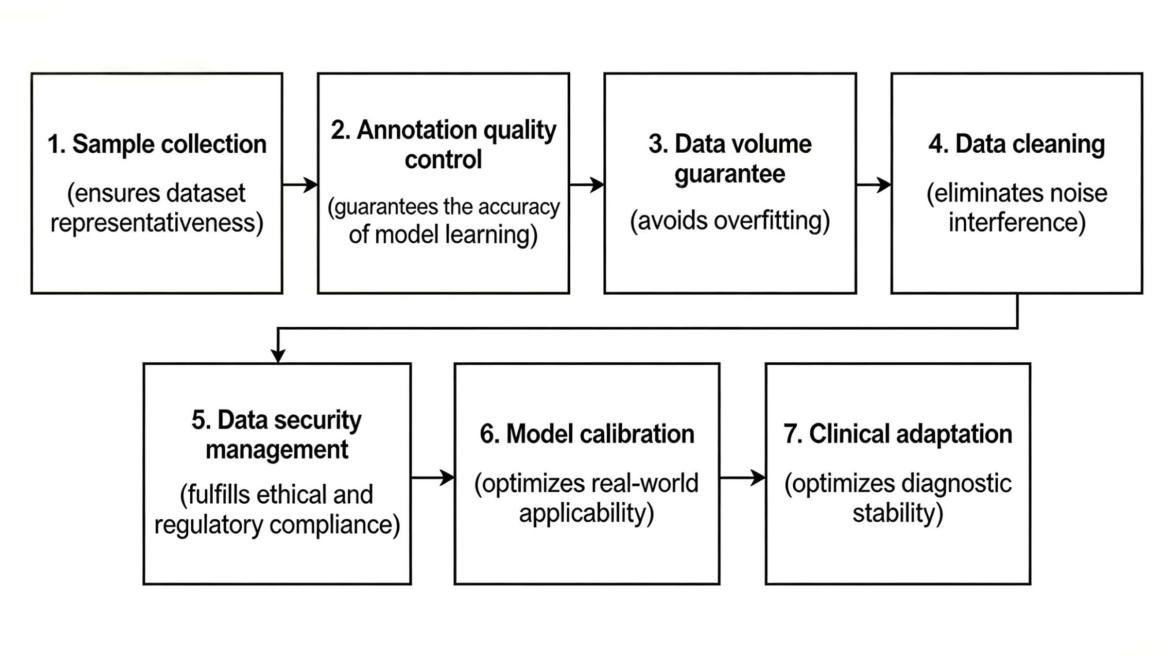
Developed by the Zhejiang Society for Mathematical Medicine and the NMPA AI Medical Device Innovation Cooperation Platform, this is the first comprehensive framework establishing standardized requirements for sample diversity and data sufficiency in cervical LBC AI datase
Key highlights
Evidence‑based (GRADE) + 3‑round Delphi expert consensus.
Clear quantitative thresholds: age/geographic/institutional/technical diversity, cell‑level annotation quality, and training/validation/test set sizes.
Emphasis on cell‑level annotations over slide counts—because AI must learn subtle nuclear and cytoplasmic features.
Mandates for platform diversity (≥2 LBC preparation systems, ≥2 scanner types) and population representativeness (rural/urban, high‑incidence regions).
The guidelines address real‑world bias—platform mismatch, scanner variability, and demographic under‑representation—that can significantly reduce detection sensitivity in underserved populations.
Full article available on ScienceDirect:
https://doi.org/10.1016/j.intonc.2026.100072
Contact Information for Intelligent Oncology:
LinkedIn: @IntelligentOncology
X: @IntelligentOnco
Facebook: @intelligentoncology
Email Address: editorialoffice@intelligent-oncology.net
Official Website: https://www.sciencedirect.com/journal/intelligent-oncology
Submission Link: https://www2.cloud.editorialmanager.com/intonc/default2.aspx