In this comprehensive review, the authors critically evaluate the current state and clinical translational potential of AI in robot-assisted radical prostatectomy (RARP). Moving beyond technical novelty, the authors examine whether AI can meaningfully improve surgical outcomes in one of the most common urologic oncologic procedures.
Key highlights
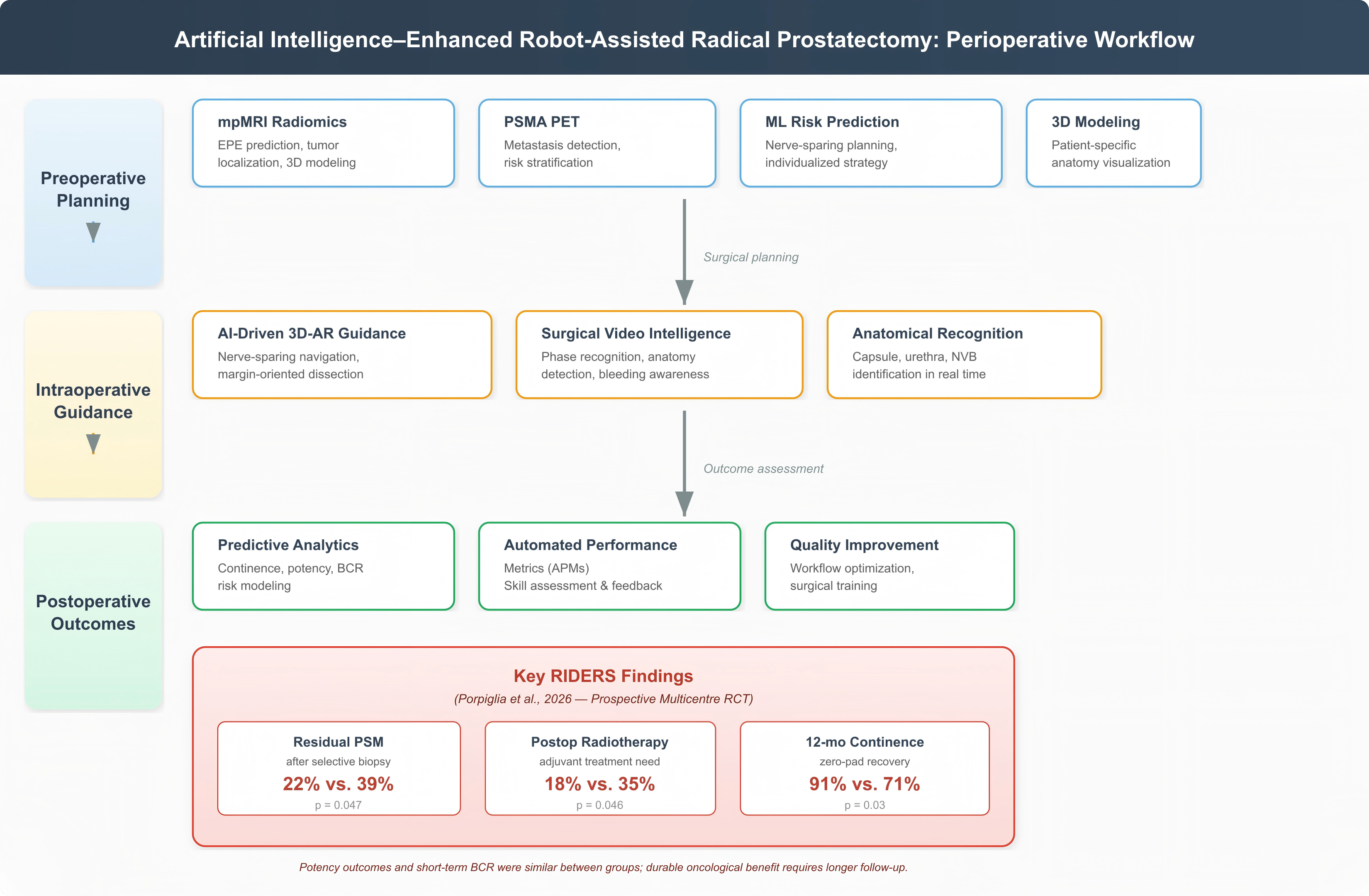
First prospective randomized evidence — The RIDERS trial demonstrated that 3D-AI-augmented reality guidance during nerve-sparing RARP reduced residual positive surgical margins (22% vs. 39%) and postoperative radiotherapy (18% vs. 35%), while improving 12-month zero-pad continence recovery (91% vs. 71%).
Clinically validated prediction models — AI models achieved an AUC of 0.77 for side-specific extraprostatic extension prediction and an external-validation AUC of 0.89 for early biochemical recurrence.
Comprehensive AI framework — The review systematically covers preoperative risk stratification, 3D-AI-driven augmented reality guidance, surgical video intelligence, predictive analytics, and objective performance assessment.
Critical translational perspective — The authors identify key barriers, including retrospective designs, heterogeneous endpoints, limited external validation, cross-platform generalizability, and regulatory uncertainty.
Clear clinical take-home — AI in RARP should be regarded as assistive rather than substitutive; its value lies in extending the surgeon's ability to interpret complex information under operative pressure.
Full article available on ScienceDirect:
https://doi.org/10.1016/j.intonc.2026.100069
Contact Information for Intelligent Oncology:
LinkedIn: @IntelligentOncology
X: @IntelligentOnco
Facebook: @intelligentoncology
Email Address: editorialoffice@intelligent-oncology.net
Official Website: https://www.sciencedirect.com/journal/intelligent-oncology
Submission Link: https://www2.cloud.editorialmanager.com/intonc/default2.aspx