Can RNA sequences help researchers find where chemical modifications are likely to occur? N⁷-methylguanosine (m⁷G) plays a role in RNA metabolism and gene regulation. Mapping these modifications experimentally can be time-consuming and costly at scale, so sequence-based predictions could help prioritize candidates for follow-up.
In Intelligent Oncology (Volume 2, Issue 4, 2026), Muhammad Tahir, Sheela Ramanna, and corresponding author Qian Liu introduce CNN-MHA-TNC, a multi-head attention model for predicting m⁷G modifications from RNA sequences in cancer research.
Research highlights
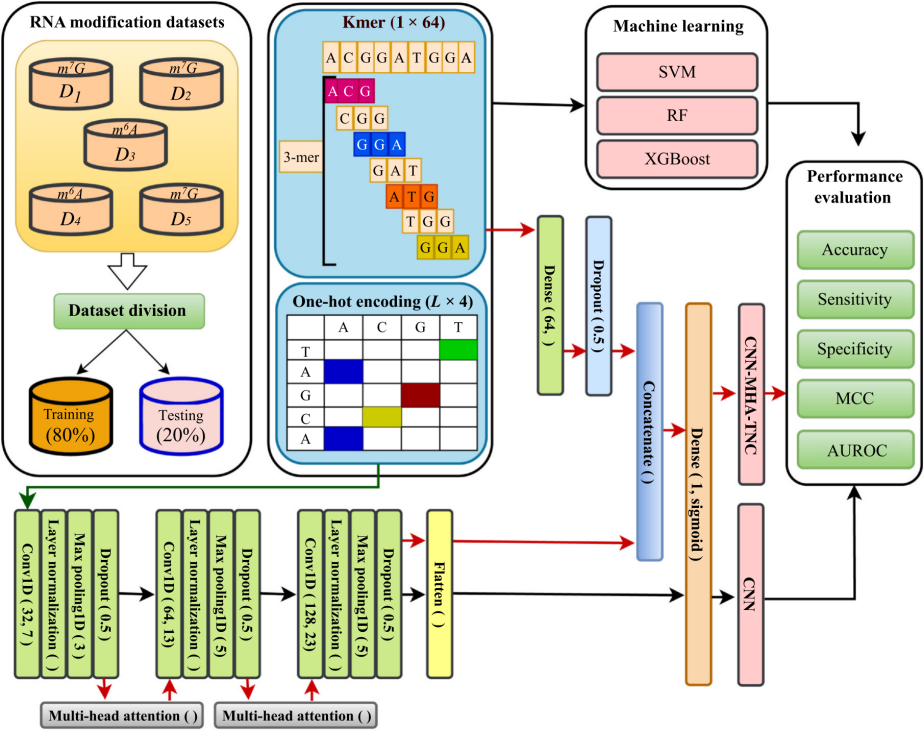
1. The model uses one-hot encoding to retain nucleotide order and trinucleotide composition to capture how often three-base patterns occur. A convolutional neural network with multi-head attention learns local patterns and their broader sequence context.
2. The team evaluated five benchmark datasets using five-fold cross-validation and held-out testing. The datasets included two m⁷G datasets from a human osteosarcoma cell line, one m⁷GHub v2.0 benchmark, and two N⁶-methyladenosine (m⁶A) datasets from a human hepatocellular carcinoma cell line.
3. Across all five held-out test sets, CNN-MHA-TNC achieved the highest mean accuracy, Matthews correlation coefficient, and area under the receiver operating characteristic curve (AUROC) among the five models evaluated. Mean accuracy ranged from 83.97% to 88.33%, and mean AUROC ranged from 0.9163 to 0.9489. Relative performance on sensitivity and specificity varied across evaluation settings.
4. The researchers used t-SNE to visualize how the model represented samples and SHAP to identify which sequence features contributed most to its classifications.
A key takeaway
Sequence-based predictions could help researchers decide which RNA sequences to examine first for m⁷G modifications. The results on the two m⁶A benchmarks suggest that the approach merits evaluation on other RNA modifications. The study used presumed negatives in the cell-line datasets, and experimental follow-up is needed to confirm predicted sites and their biological roles.
Looking ahead
Future studies could evaluate the model in additional cancer types and patient-derived samples and use experimentally confirmed negative examples. Predictive performance declined on osteosarcoma sequences longer than 5,000 nucleotides. Models that handle full-length sequences and incorporate RNA secondary structure could be evaluated for improved performance.
Read the full article on ScienceDirect
https://doi.org/10.1016/j.intonc.2026.100089
Contact information for Intelligent Oncology
LinkedIn: @IntelligentOncology
Bluesky: @Intelligent Oncology
X: @IntelligentOnco
Facebook: @intelligentoncology
Email Address: editorialoffice@intelligent-oncology.net
Journal website: https://www.sciencedirect.com/journal/intelligent-oncology
Submit a manuscript: https://www2.cloud.editorialmanager.com/intonc/default2.aspx